Photo proof of delivery: Practical SOPs for small UK couriers to resolve disputes, capture signatures and handle parcel-not-received claims
10 Nov 2026 · 15 min read
14 min read
Key takeaways
- Combine a timestamped photo, delivery signature capture and clear safe-place notes to build a concise evidence bundle that resolves most "parcel not received" and damage disputes.
- Industry context: in Ofcom's 2025 survey, 68% of parcel users reported a delivery issue in the previous six months, and 26% reported parcels left in an inappropriate location, so consistent POD practice reduces frequent disputes.
- Use a standard evidence package for claims: job reference, delivery history, photos with filenames/timestamps, signature + typed name/role or refusal record, safe-place notes and contact logs.
- Enforce a one-page SOP and weekly KPIs such as usable-photo rate and median evidence retrieval time, target retrieval < 24 hours and usable-photo rate > 90%.
Table of contents
- What proof of delivery disputes do small couriers actually face, and why do they happen?
- How do proof of delivery disputes affect operations, customer relationships and insurance outcomes?
- What exactly is photo proof of delivery and how does it differ from paper POD, barcode scans and electronic logs?
- How does delivery signature capture strengthen your case for a parcel not received claim?
- What should a good delivery photograph show to resolve proof of delivery disputes?
- When is a photo alone sufficient, and when do you need a signature or additional notes?
- What are defensible “safe-place” note templates and phrases?
- How should delivery signature capture be performed to maximise legal and insurance weight?
- How should drivers handle difficult situations at point of delivery?
- How do you structure day-to-day SOPs so every driver follows consistent POD practice?
- What training, equipment and simple quality checks do drivers need?
- How should digital POD records be stored, named and retained?
- What evidence package should you prepare for a parcel not received claim?
- How should you respond when a customer raises a never arrived dispute?
- How can live tracking and automatic updates reduce disputes and speed resolution?
- How does photo proof of delivery, delivery signature capture and tracking create a continuous audit trail?
- How does Lodway handle photo proof of delivery and signature capture in practice?
- What will day-to-day workflow look like for a small courier using Lodway?
- What simple checks and KPIs should management run weekly?
- How to balance speed, driver safety, bad weather and GDPR with POD needs?
- Conclusion: immediate next steps for owners and directors
- Common mistakes, trade-offs and edge cases
What proof of delivery disputes do small couriers actually face, and why do they happen?
Small courier firms commonly see three dispute types: parcel not received, damaged parcel and delivery to the wrong recipient or insecure location. These arise from missed knocks, rushed drops, unclear safe-place choices or absent documentary evidence.
- Typical dispute types: “never arrived / parcel not received claim”, damaged parcel, wrong recipient, refusal to sign, neighbour or third-party acceptance, mis-located safe-place.
- Root causes: rushed routes, poor photo framing or missing photos, no signature or illegible signature, vague safe-place notes, lack of chain-of-evidence, poor customer communication.
- Scale and context: 68% of parcel users reported a delivery issue in the previous six months in Ofcom's 2025 survey, see Ofcom; the 2026 figure rose to 71%, see our Ofcom 2026 report summary.
- Inappropriate drops: 26% reported parcels left in an inappropriate location, see Ofcom.
- Citizens Advice: found 37% reported a problem with their most recent parcel and estimated a record 15 million people had a problem with their latest delivery, in a one-month snapshot in 2025, see Citizens Advice.
How do proof of delivery disputes affect operations, customer relationships and insurance outcomes?
Disputes consume staff time, reduce throughput and damage customer loyalty, and weak evidence can weaken insurance outcomes.
- Operational cost: investigations, customer calls, admin and re-deliveries divert staff hours and reduce driver throughput.
- Customer relationship risk: fewer than half of customers are satisfied with how parcel firms handle problems, with 45% satisfied with contacting a parcel operator and 46% with complaint handling in 2025, per Ofcom.
- Insurance outcomes: insurers typically rely on a clear evidence package, photos, signatures and timestamps, but there is no universal insurer acceptance standard, check your policy, see our goods in transit insurance guide.
What exactly is photo proof of delivery and how does it differ from paper POD, barcode scans and electronic logs?
Photo proof of delivery is a timestamped image attached to the job showing where or how a parcel was left, providing visual context that scans and status codes do not.
Definitions
- Photo proof of delivery: a photograph linked to a job showing parcel placement or condition.
- Paper POD: a physical signed record of delivery, handwritten signature, date and notes.
- Electronic delivery log: a digital record of status events and timestamps.
- Barcode scan: links a parcel ID to an event, useful for chain of handling.
Comparison table
| Option | Evidence provided | Best use |
|---|---|---|
| Photo POD | Visual context, placement, visible damage | Unattended drops, damage record |
| Electronic signature | Apparent recipient acceptance | Direct handovers, higher-value parcels |
| Barcode scan | Parcel ID linked to event | Chain-of-handling and depot control |
| Paper POD | Handwritten signature and notes | Offline fallback or customer requirement |
| Photo + signature + timestamp | Visual + acceptance + time | High-value, insured or disputed deliveries |
Limitations: scans do not prove who took the parcel, photos do not prove who picked it up and signatures can be illegible or disputed.
How does delivery signature capture strengthen your case for a parcel not received claim?
A captured delivery signature ties an acceptance event to the job and, when paired with a typed name and role, makes it harder for a claimant to dispute receipt, although signatures must be supported by context.
- What to record: clear signature image, typed or printed name, relationship or role, system-generated date/time and job link.
- How to capture: keep device steady, require typed name immediately after signature, include acceptance type such as handed to, left with or refused.
- Limitations: illegible signatures, third-party acceptance and accessibility needs mean signatures are not always possible; there is no legal guarantee a signature proves delivery, and you should be cautious with insurers or claimants.
What should a good delivery photograph show to resolve proof of delivery disputes?
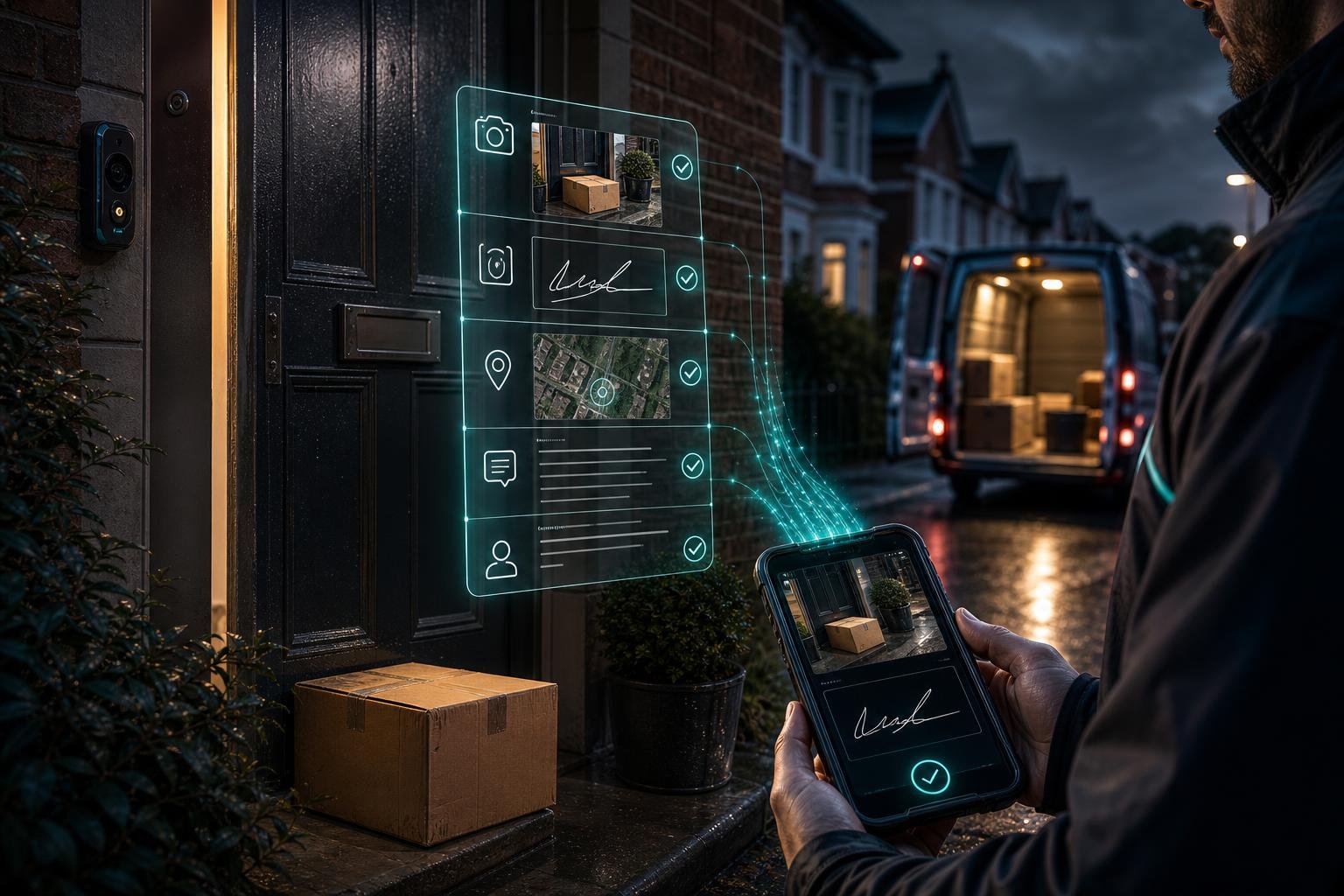
A useful delivery photo shows context such as doorway or landmark, parcel position relative to that context, readable elements of the parcel label where practical, and any visible damage, plus timestamp metadata.
- Framing and context: take a wide shot showing door, porch or house number and a close-up of the parcel label if privacy allows.
- Placement: show parcel relative to fixed features such as door, gate or postbox.
- Parcel condition: show packaging integrity and any damage.
- Metadata: include timestamp, geotag and job link where your app provides them.
- Multiple shots: take two images where practical, one wide and one close-up.
- Privacy: avoid neighbours’ faces; if captured, blur before sharing externally and log why the wider image was needed.
Mini checklist drivers can follow
- Wide shot showing door number or clear landmark.
- Close-up of parcel label and condition.
- Confirm timestamp and job attachment in the app.
When is a photo alone sufficient, and when do you need a signature or additional notes?
A photograph alone can be sufficient for unattended safe-place drops that clearly show location and intact packaging; require signatures for higher risk or contractual needs.
- Low-value, authorised safe-place: photo plus timestamp may suffice.
- Medium/high-value or insured items: require signature, photo and precise notes.
- Merchant requires signature: obtain it or record refusal.
- Edge cases: no answer, refusal or damage require additional logs, photos and notes.
- Caution: insurer standards vary, do not assume universal acceptance of any single evidence set.
What are defensible “safe-place” note templates and phrases?
A defensible safe-place note is precise, factual and consistent, stating location, reason, visibility, parcel condition and evidence references.
Template you can paste:
- Delivered to: [precise location].
- Reason: [recipient unavailable / authorisation].
- Parcel position: [e.g. under covered porch, left of doormat, behind black recycling bin].
- Visibility and access: [visible from public footpath / not visible, behind gate].
- Condition: [packaging intact / damage noted].
- Evidence: [photo #1 wide / photo #2 label close-up].
- Time: [system timestamp].
Three UK examples:
- Terraced house porch: Delivered to: under covered porch, left of doormat. Visibility: visible from pavement. Condition: packaging intact. Evidence: photo1_wide/photo2_label. Time: 2026-11-10T09:22.
- Flat with concierge: Delivered to: left with concierge (name: Sam, role: concierge). Visibility: behind foyer counter. Condition: intact. Evidence: photo1. Time: 2026-11-10T11:05.
- Apartment communal foyer: Delivered to: inside communal foyer, on shelf to the right of bin store. Visibility: not visible from street. Condition: slight dent. Evidence: photo1/photo2. Time: 2026-11-10T15:30.
Why this works: precision reduces ambiguity for customers, insurers and merchants. See reporting by Ofcom and Citizens Advice.
How should delivery signature capture be performed to maximise legal and insurance weight?
Capture a clear signature image plus the signer’s printed name and relationship, timestamp and attach all to the job, and record refusals or third-party acceptance with role information.
- Hold device steady and ask signer to print their name legibly in the typed field immediately after signing.
- Confirm role: record neighbour, reception or spouse.
- If signature illegible, require typed name and a short factual note about any identity check without forcing ID checks.
- If refused, tick refused to sign, take a photo and note reason.
- Capture witness signature where available and record witness name and role.
How should drivers handle difficult situations at point of delivery?
Follow a branching SOP: attempt polite contact, capture evidence, record actions and do not record delivered if handover did not occur.
Numbered SOP steps drivers should follow
- No answer, knock or ring once, wait 30 to 60 seconds, log times, take a wide photo if leaving and leave card or SMS if company policy requires.
- Refusal to sign, record refusal, take photo of parcel at doorstep and capture any offered printed name.
- Damaged parcel found on arrival, photograph damage from multiple angles before handing over; if recipient accepts, add a damage note and notify merchant.
- Unsecured drop, if location is insecure and instructions forbid leaving, do not leave, return to depot or follow redelivery policy.
- Accessibility needs, make reasonable adjustments; if signature not possible, record witness or acceptance note.
How do you structure day-to-day SOPs so every driver follows consistent POD practice?
A short enforced checklist with mandatory fields reduces variance: scan, confirm address and instructions, attempt handover, capture photo if unattended, get signature if required, attach evidence and notify customer.
Driver workflow (one-page SOP)
- Scan parcel barcode in app to link parcel ID to the job.
- Confirm delivery address and instructions; note deviations.
- Attempt delivery: knock, ring and call, log times.
- If handed over: capture delivery signature, typed name and role.
- If unattended: take wide photo and close-up of label if allowed, complete safe-place template.
- If damage or refusal: take multiple photos and record reason in notes.
- Sync evidence to server before closing job; only send delivered notification once evidence is attached.
- If offline, follow paper fallback with chain-of-custody and upload at depot.
Use your app to make required fields mandatory where possible.
What training, equipment and simple quality checks do drivers need?
Provide short training on camera technique, SOP checklist and data protection basics, and equip drivers with reliable phones, chargers and a stylus.
- Training topics: framing, lighting, avoiding unnecessary PII, signatures, safe-place wording, refusal and damage handling, GDPR basics. See ICO retention guidance.
- Equipment: smartphone with decent camera, power bank, stylus, offline paper POD forms.
- Daily checks: sample 5 to 10 PODs per driver for image clarity and completeness and retrain where needed.
How should digital POD records be stored, named and retained?
Store POD evidence attached to the job in a secure, access-controlled system with a documented retention schedule aligned to ICO guidance.
- File naming: [JobRef]_[YYYYMMDD]_[type]_[driverID] for example J12345_20251103_photo1_JD.
- File formats: JPEG or PNG for photos, PDF for bundled records; confirm which metadata your app records.
- Retention: document a retention schedule per ICO guidance and do not adopt a default without checking contracts and insurers.
- Access control: restrict to authorised staff, log access and create a chain-of-custody for evidence exports.
- Retrieval KPI: median time to retrieve complete evidence, target under 24 hours.
What evidence package should you prepare for a parcel not received claim?
Provide a concise bundle in chronological order: job reference, delivery history, photos, signature and typed name, safe-place notes, timestamps and contact logs.
- Job and consignment reference and barcode ID.
- Collection and delivery addresses and times.
- Delivery status history and log.
- Photographs with file names and timestamps.
- Signature image plus typed name and role or refusal record.
- Safe-place, neighbour or damage notes.
- Driver and vehicle ID where lawful.
- Customer notification history such as SMS or email.
- Internal investigation timeline and witness statements as available.
- Statement of insurance status if requested and chain-of-custody or access log for evidence files.
How should you respond when a customer raises a never arrived dispute?
Respond quickly and in structure: acknowledge, gather customer evidence, retrieve and send your evidence package, and propose next steps with timeframes.
- Immediate (within 24 hours): acknowledge and request customer photos, CCTV or neighbour information.
- Short investigation (48 to 72 hours): retrieve evidence package and email a concise summary with POD evidence.
- Provisional resolution: if evidence supports unattended drop and customer accepts, offer remedy per terms and conditions; if disputed, escalate to insurer or merchant and set expectations.
- Templates: acknowledgement, request for customer evidence, summary of courier evidence and escalation steps. CC merchant or insurer where appropriate and redact unnecessary personal data.
For how common these complaints are, see Ofcom and Citizens Advice.
How can live tracking and automatic updates reduce disputes and speed resolution?
Live tracking and automatic updates reduce uncertainty by giving recipients an expected delivery window and a record of delivery events, lowering dispute volume.
- Booking to tracking link to status updates to delivery evidence and customer notification reduces calls and escalations. See our guide to delivery tracking links.
- When customers can see a delivery attempt or photo they are less likely to escalate.
How does photo proof of delivery, delivery signature capture and tracking create a continuous audit trail?
A continuous audit trail links booking, scans, tracking events, notifications, timestamped photos and signatures into a single job record, clarifying the timeline and making records searchable.
- Suggested flow: booking, dispatch, barcode scan, driver app events such as photo and signature, server sync, customer notification and stored job record.
- Strong linkage requires automatic attachments, reliable server timestamps and access logs; confirm which metadata your software captures and how long you keep it, see ICO guidance.
How does Lodway handle photo proof of delivery and signature capture in practice?
In Lodway, drivers capture photos and signatures in the driver app and they attach to the job, every job gets a live tracking link, and customers get automatic email and text updates.
- Driver app: photo and signature proof of delivery captured at the door and stored against the job.
- Tracking and updates: customers follow the delivery on a tracking link and receive email and text updates, see our guide to delivery tracking links.
- Customer portal: business customers get their own portal with credit accounts.
What will day-to-day workflow look like for a small courier using Lodway?
Typical sequence: the driver opens the job, attempts delivery, captures a signature or photos with notes, and the customer gets an update; the office then finds the evidence on the job record.
- Driver goes to the address and attempts handover (knock and call).
- Captures a signature if handed over, or takes wide and close-up photos and adds a safe-place note if unattended.
- Completes the job; the office reviews the attached evidence and sends it to claimants or insurers as needed. See how Lodway works.
What simple checks and KPIs should management run weekly?
Track a few KPIs weekly and act on outliers, for example usable-photo rate, signature coverage, retrieval times and disputes per 1,000 deliveries.
- % unattended deliveries with usable photo, where usable means clear and shows context.
- % required-signature deliveries with signature and typed name.
- Median time to retrieve complete evidence, target under 24 hours.
- Disputes per 1,000 deliveries and % resolved with existing evidence.
Suggested triggers: usable-photo rate under 90% requires retraining; median retrieval time over 48 hours needs process or IT fix.
How to balance speed, driver safety, bad weather and GDPR with POD needs?
Set minimal mandatory evidence for routine drops and richer evidence for riskier deliveries, never force unsafe actions and follow ICO retention guidance.
- Trade-offs: define which parcels need full evidence, set an acceptable extra time per stop and measure throughput impact.
- Safety: never force drivers into unsafe situations or private property without consent.
- Weather and low light: use flash or take extra photos and note when quality is poor.
- GDPR and retention: document retention schedule per ICO guidance.
Conclusion: immediate next steps for owners and directors
Start with three actions today: issue a one-page POD SOP, run a short briefing and sample recent PODs for quality, and set up a retention schedule referencing ICO guidance.
- One-page SOP: scan, attempt, photo or signature, safe-place note, attach and notify.
- Driver briefing script: show wide and close-up photo technique, typed name after signature and safe-place template use.
- Evidence folder checklist: assemble claim bundles as described in the evidence package section.
- Try Lodway free for 14 days, with no setup fee, to test photo and signature capture on real jobs.
Common mistakes, trade-offs and edge cases
Common errors to avoid include assuming a delivered status proves the correct recipient received the parcel and photographing only a parcel close-up without context.
- Photographing only a parcel close-up without context.
- Capturing a signature but not the printed name or acceptance reason.
- Leaving parcels in insecure locations with vague safe-place notes.
- Retaining personal data without a documented retention schedule, see ICO guidance.
- Assuming photos or signatures are universally accepted by insurers.
Frequently asked questions
What counts as proof of delivery in the UK?Direct answer: Proof of delivery can include scans, photographs, signatures, timestamps and delivery notes; there is no single mandated format in the UK. Provide a clear, linked evidence pack.
Context: official reporting and guidance do not require one format, so bundle multiple elements when possible. See Ofcom for sector context.
Is a delivery photograph enough to defeat a parcel not received claim?Direct answer: A clear photo showing location and intact packaging can be decisive for unattended drops, but it may not prove recipient identity for high-value items.
Context: for higher-value or contested deliveries add a signature, witness or typed name. See research from Citizens Advice.
Is a signature legally required for every delivery?Direct answer: No, there is no blanket UK legal requirement for a signature on every delivery; obtain one when contract terms, merchant instructions or risk profile require it.
Context: require signatures for COD, insured, high-value or merchant-mandated deliveries and record refusals when they occur.
How long should I keep POD photos and signatures?Direct answer: Keep records according to a documented retention schedule tailored to contracts, insurer windows and ICO guidance; do not retain personal data indefinitely.
Context: follow the ICO retention guidance and align retention times with insurers and merchant contracts.
What should I do if a customer disputes a signed POD?Direct answer: Retrieve the evidence bundle including signature image, photos, timestamps and tracking history, send a concise summary within 48 to 72 hours and escalate to insurer or merchant if unresolved.
Context: include job reference, delivery log, photos and any witness statements. Use the evidence package checklist above.
Can I share delivery photos with insurers without breaching GDPR?Direct answer: Yes, you can share necessary evidence with insurers where lawful, but redact unnecessary personal data and follow documented retention and access controls under ICO guidance.
Context: ensure you have a lawful basis such as contractual necessity, legitimate interest or consent, and log access and disclosures per ICO guidance.