Will delivery robots replace couriers UK — Not yet: selective automation, local pilots and practical steps for small couriers
16 Oct 2026 · 7 min read
6 min read
Key takeaways
- Delivery robots are augmenting couriers, not broadly replacing them, with pilots and local services rather than nationwide displacement.
- Starship reported more than 9 million deliveries, 19 million km travelled, and 2,700 robots across 270 locations in its October 2025 update, reflecting scale in pockets.
- Current pavement robots are short-range, with Starship's planned Uber Eats service specified for deliveries of up to 2 miles and expected times under 30 minutes.
- There is no independent UK statistic showing widespread courier job losses from delivery robots, so effects are currently local and mixed.
Table of contents
- Are delivery robots replacing UK couriers?
- How far can autonomous delivery robots UK travel and what can they actually do?
- What is the impact of delivery robots on couriers and local labour?
- What are the legal and public-space issues?
- How should small courier companies adapt?
- Options compared
- Bottom line
Are delivery robots replacing UK couriers?
No, current deployments show selective automation for short local trips, not a national replacement of human couriers.
The clearest UK developments are pilots and commercial services rather than full substitution of courier fleets. Starship’s long-running grocery service began in the UK in 2018, and the company announced an Uber Eats partnership for Leeds in December 2025. See Starship's about page and the Starship press release on the Uber Eats partnership for details.
For small courier businesses the practical effect is that robots change the shape of some short delivery tasks, so operators should plan for mixed fleets and new dispatch rules rather than expect an immediate collapse of demand for drivers. See Starship's about page for company context.
How far can autonomous delivery robots UK travel and what can they actually do?
Short answer, robots operate for short, local trips, typically under a few miles and with quick delivery windows.
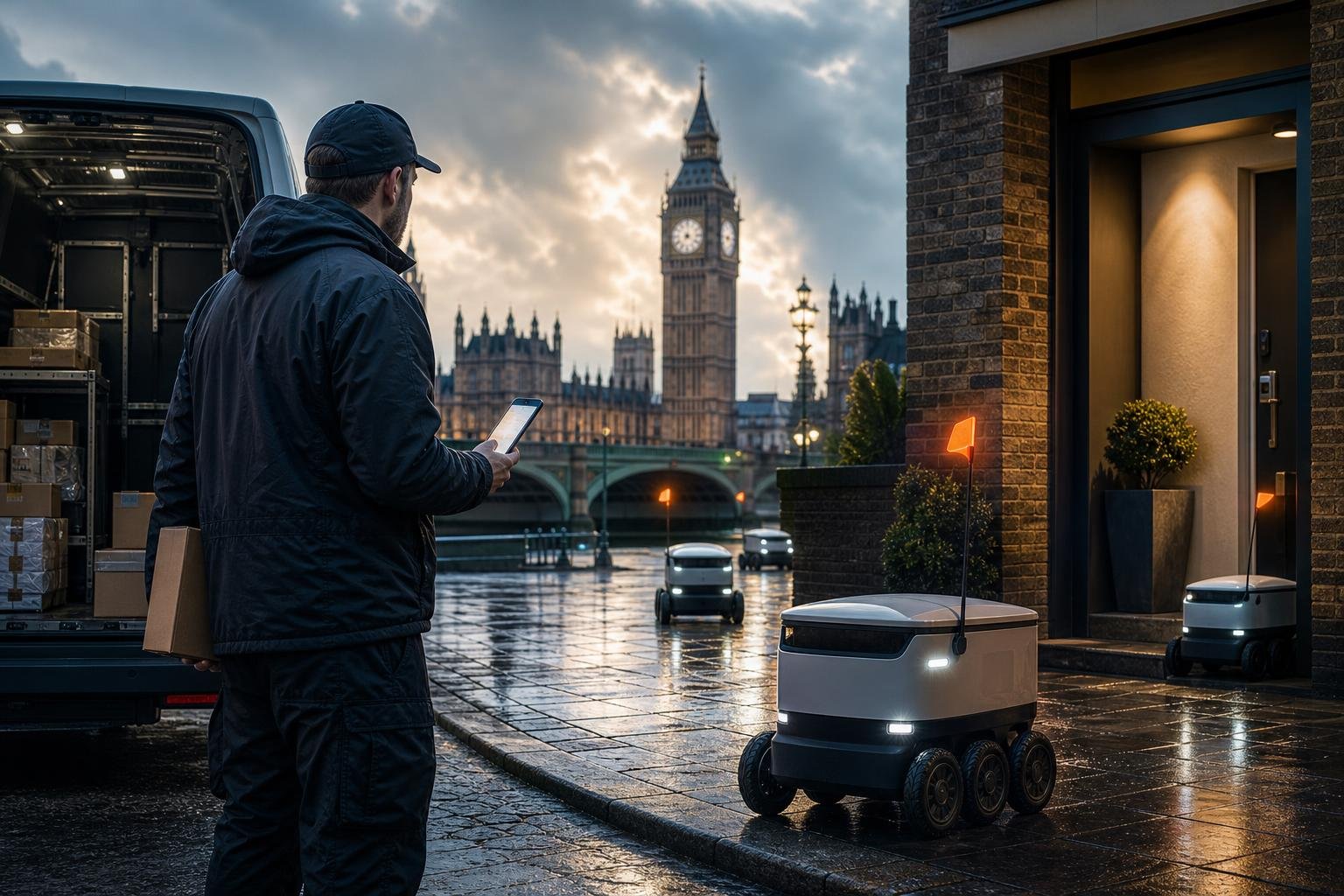
Starship's planned Uber Eats service specifies deliveries of up to 2 miles and expected delivery times of under 30 minutes, so the practical envelope today is short, local trips.
Company activity figures show scale in pockets: Wikipedia reported more than 7 million deliveries and 8.5 million miles by October 2024, and Starship's 2025 update cites more than 9 million deliveries, 19 million km travelled, and 2,700 robots across 270 locations, illustrating growth in select areas. See Starship Technologies on Wikipedia and the Starship press release.
Limitations to note
Robots face capacity, pavement, weather, road-crossing and building-access constraints, so they work best for small, repeatable grocery or takeaway runs inside compact areas rather than multi-drop van rounds or rural addresses.
Starship reports its global fleet performs more than 100,000 road crossings per day and can operate with Level 4 autonomy within its service design, while still using remote assistance for exceptions. See Starship's press materials and Starship's about page.
What is the impact of delivery robots on couriers and local labour?
Short answer: impact is mixed and local, not a measured national job loss.
- Company-commissioned forecasts suggest local economic gains, for example a Prysm Global report commissioned by Starship projects a £125 million increase in UK grocery spending if personal delivery devices expand nationwide, and estimates 555 jobs in local manufacture and maintenance with almost £11 million in cumulative wages to 2035. See reporting at The Grocer.
- Warehouse automation is a separate effect: DHL reports more than 2,000 robots in UK, Ireland and EMEA operations, 750 assisted-picking robots at 18 sites, and €1 billion spent on automation over three years, which improves depot efficiency but does not directly replace pavement couriers.
- There is currently no independent UK statistic showing widespread courier job losses caused by delivery robots; available reporting documents deployments and plans but not national displacement figures. See Starship press materials.
For small courier companies the practical takeaway is to expect some task-shifting, where short runs may be automated, while demand for flexible, complex and rural deliveries remains for human drivers.
What are the legal and public-space issues?
The legal position is uncertain and varies by context, with historic statutes and new vehicle laws creating a mixed picture.
- The UK’s Automated Vehicles Act 2024 covers some self-driving vehicles, but reporting indicates pavement delivery robots were not included in its scope, so the law does not neatly cover personal delivery devices. See coverage at Retail Tech Innovation Hub and local industry commentary at Pegasus Couriers.
- Much of the legal discussion still refers to older statutes such as the Highways Act 1835, illustrating a mismatch between historic law and modern pavement robots. See Pegasus Couriers.
- The term personal delivery device (PDD) is used in industry debate, but reporting says UK law has no statutory definition, leaving liability, obstruction and enforcement questions open. See Starship's about page and coverage at The Grocer.
Local authorities often decide whether and how robots operate in their areas, so operating conditions can differ from town to town. See Starship's about page and local commentary at Pegasus Couriers.
How should small courier companies adapt?
Short answer: plan for a hybrid future, protect the jobs you rely on, and use courier dispatch software for mixed fleets.
Recommended steps to adapt:
- Identify which jobs are robot-suitable (short, light, predictable, urban) and which are not (multi-drop parcels, heavy grocery orders, rural addresses). Effort: low; time: a couple of route reviews.
- Set up dispatch rules to route robot-suitable jobs to a different handling queue and human jobs to drivers. Effort: medium; requires a dispatch system that supports mixed fleets and rules. See dispatch platforms such as Lodway for examples.
- Pilot a mixed-fleet workflow with clear handoffs, proof of delivery expectations and exception handling. Effort: medium; pilot for 2–6 weeks for a small set of postcodes.
- Use a driver app and live tracking to manage exceptions and record proof of delivery. Effort: medium; needs driver training. See Lodway's blog for feature examples.
- Protect revenue by offering business accounts, online booking and card payments into your own account rather than relying on marketplace platforms.
You should consider a dispatch platform that supports mixed fleets, a driver app with photo and signature PODs, live tracking links for customers, automatic updates, and invoicing. Lodway provides these features and can be trialled with a 14-day free trial. See Lodway for details.
Common mistakes to avoid
- Treating pilot robot services as evidence of nationwide replacement. See Starship's about page.
- Treating company forecasts as measured outcomes, Prysm/Starship forecasts are not audited national results. See reporting at The Grocer.
- Confusing warehouse robots with pavement delivery robots, they solve different problems. See DHL's automation press release and industry reports such as Mordor Intelligence.
Options compared
The following table compares common last-mile options, summarising evidence, advantages and limits.
| Option | Cost and time evidence available | Advantages | Disadvantages / limits |
|---|---|---|---|
| Human bicycle or motorcycle courier | No verified UK cost-per-delivery figure provided | Flexible routes, handles stairs and building access | Labour-dependent, weather and traffic exposure |
| Human van courier | No verified UK cost-per-stop figure provided | Handles larger parcels and multi-drop routes | Vehicle, fuel, parking and congestion costs |
| Autonomous pavement robot | Starship specifies up to 2 miles and under 30 minutes for Uber Eats; no verified UK cost-per-delivery figure provided. See the Starship press release. | Suitable for short, repeatable local deliveries | Limited capacity and range, legal and accessibility uncertainty |
| Warehouse / depot robot | DHL reports 2,000+ robots, 750 assisted-picking robots at 18 sites, and €1bn automation investment. | Improves picking and internal efficiency | Does not replace last-mile couriers on pavements |
| Hybrid human–robot model | No verified UK cost comparison provided | Balance of robot efficiency for short trips and people for complex tasks | Needs dispatch rules, maintenance and monitoring |
Bottom line
The UK market is moving toward selective automation of short local deliveries rather than an immediate wholesale replacement of couriers.
Key unresolved issues are verified unit economics, pavement accessibility, liability, local-authority control and a clear legal category for personal delivery devices (PDDs). See Starship's about page and industry commentary at Pegasus Couriers.
If you run a small courier company, treat robots as a future change to plan for, not an immediate existential threat. Start by auditing routes, testing rule-based dispatch for short trips, and choosing dispatch software that handles mixed fleets and fast exceptions. See dispatch platform examples at Lodway.
Frequently asked questions
Will delivery robots work in rural areas?No, current robots are designed for short, pavement-based urban trips and struggle with rural terrain, long distances and stairs. See the Starship press release for service range details.
Are robots taking courier jobs today?No, not at national scale; deployments are local and there is no independent data showing widespread job losses caused by robot delivery. See reporting from Starship.
How soon should I change my dispatch system?Change when you can run a short pilot and create rules for robot-suitable jobs, this is typically a months-long review, pilot and roll-out rather than an overnight switch. See dispatch platform guidance at Lodway.
Do robots reduce costs per delivery?Not conclusively, providers claim efficiency gains, but there is no verified UK cost-per-delivery comparison in the available reporting; treat vendor cost claims cautiously. See Starship's about page for company claims.
How do robots affect accessibility for disabled people?The effect is mixed, robots may help some customers access groceries, but campaigners warn they can compete for pavement space with disabled pedestrians, creating accessibility concerns. See reporting at The Grocer and Starship's about page.
How can my dispatch software handle robot handoffs?Use a system that supports mixed fleets, configurable dispatch rules, driver apps for exceptions, POD capture and clear logging of handoffs, which lets you operate a hybrid model reliably. See platform examples at Lodway.